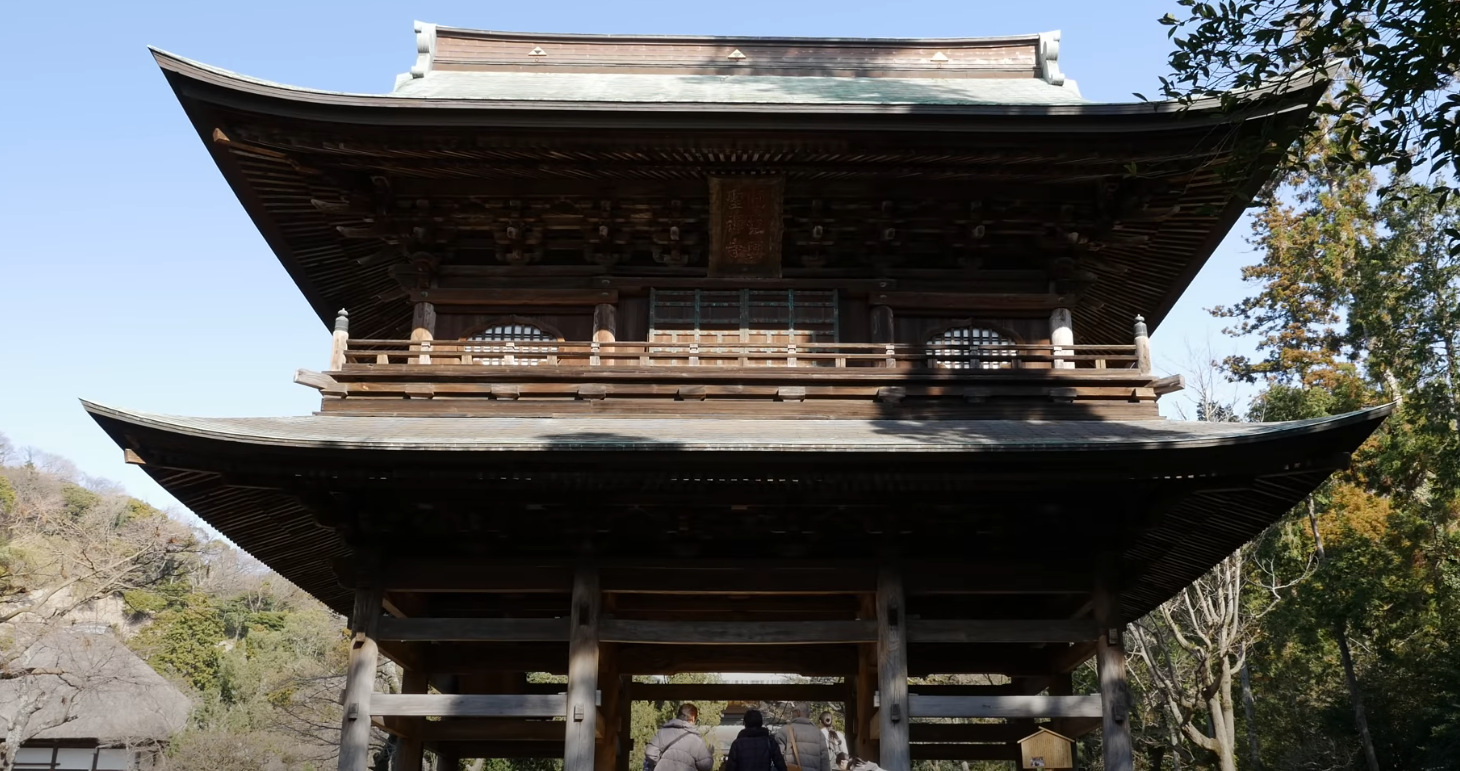
About the temple
Engaku-ji is one of the five great Zen temples of Kamakura, collectively known as Kamakura Gozan, and holds second place in this sacred hierarchy. Founded in 1282 at the city's gates, the complex extends across the forested slopes of the mountains surrounding Kamakura, creating a succession of gardens, pavilions, and meditation halls that gently ascend the mountain. With its moss-covered roofs, silent bamboo groves, and the mist that frequently envelops its paths, Engaku-ji conveys with exceptional intensity the essence of Zen Buddhism: the search for enlightenment through simplicity, discipline, and absolute presence in the moment. It is also one of the few great Zen temples in Japan that maintains an active monastic community and offers zazen practice open to the public.
History
The founding of Engaku-ji in 1282 is intimately linked to one of the most dramatic moments in Japanese medieval history: the Mongol invasions. Between 1274 and 1281, the fleets of Kublai Khan's Mongol Empire attacked Japan on two occasions. Although the Kamakura shogunate managed to repel both invasions — the second with the decisive help of the legendary typhoons known as kamikaze or 'divine winds' — the human cost was enormous. Tens of thousands of Japanese and Mongol warriors died in the fighting. Regent Hojo Tokimune, who had directed Japan's defense with extraordinary determination, decided to found a great Zen temple to honor the fallen on both sides, Japanese and Mongols alike, in an unprecedented gesture of Buddhist compassion. To preside over the new temple he summoned from China the Zen master Wuxue Zuyuan, known in Japan as Mugaku Gengo, who became Engaku-ji's first abbot. Under the patronage of the Hojo clan and later the Ashikaga shoguns, Engaku-ji reached its peak splendor in the 14th century, with more than forty sub-temples and a monastic community of several hundred monks. The temple became the main center of Rinzai Zen Buddhism in eastern Japan, exercising a cultural and philosophical influence that extended to architecture, the arts, the tea ceremony, and martial arts. Subsequent centuries were less favorable. Several devastating earthquakes, especially that of 1923 which leveled much of Kamakura, reduced the complex to a fraction of its original size. Reconstruction was slow and laborious, and some of the original buildings were lost forever. However, what survives is of exceptional architectural quality, and the temple keeps alive the Zen spirit that inspired its founding. In the late 19th century, the temple was visited by writer Natsume Soseki, who practiced zazen here for several weeks in an attempt to find peace of mind. The experience, described in his essay 'Ten Nights of Dreams', marked him deeply and helped spread knowledge of Zen among the Japanese intelligentsia of the Meiji era.
🎴 Curiosities
The Shariden is a National Treasure containing Buddha relics
The great bell Ogane is also a National Treasure
Serene atmosphere in a forested valley
Engaku-ji was founded to honor the dead of the Mongol invasions on both sides — Japanese and enemies alike — in a gesture of Buddhist compassion extraordinary for its time
The Zen master who presided over its founding, Wuxue Zuyuan, came expressly from China. According to legend, when his ship was attacked by pirates during the crossing, the master remained seated in meditation without flinching, which so intimidated the pirates that they desisted
Engaku-ji's great bell dates from 1301 and is a National Treasure. It measures 2.6 meters high, weighs 2,000 kg, and is struck 108 times on New Year's Eve — the number of worldly illusions that Buddhism identifies and which the bell's sound helps to purify
Writer Natsume Soseki, considered the father of modern Japanese literature, practiced zazen here in 1894. He wrote about the experience cryptically but revealingly: 'Zen cannot be explained, only experienced'
Engaku-ji offers zazen sessions open to the public every Sunday morning — a unique opportunity to practice Zen meditation in an authentic monastic setting with over 700 years of history
The Shariden reliquary, classified as a National Treasure, is the only surviving example of Song Chinese architecture in Japan. It was built to house a tooth of Buddha brought from China, though its authenticity has been debated by historians
The Great Kanto Earthquake of 1923 destroyed more than half of the complex's buildings. Reconstruction took decades and some sub-temples never recovered, reducing the complex from over 40 to barely a dozen main buildings
The path from Kita-Kamakura train station to the temple is itself an experience: just 200 meters lined with bamboo, stone, and moss that prepare the visitor for the interior atmosphere
In spring the peonies of the inner garden bloom creating a spectacle of color that contrasts sublimely with the sobriety of the Zen buildings
The temple maintains one of the few active Rinzai Zen schools in eastern Japan, where monks follow the same practice regime as their medieval predecessors: rising before dawn, meditation, manual work, study, and more meditation