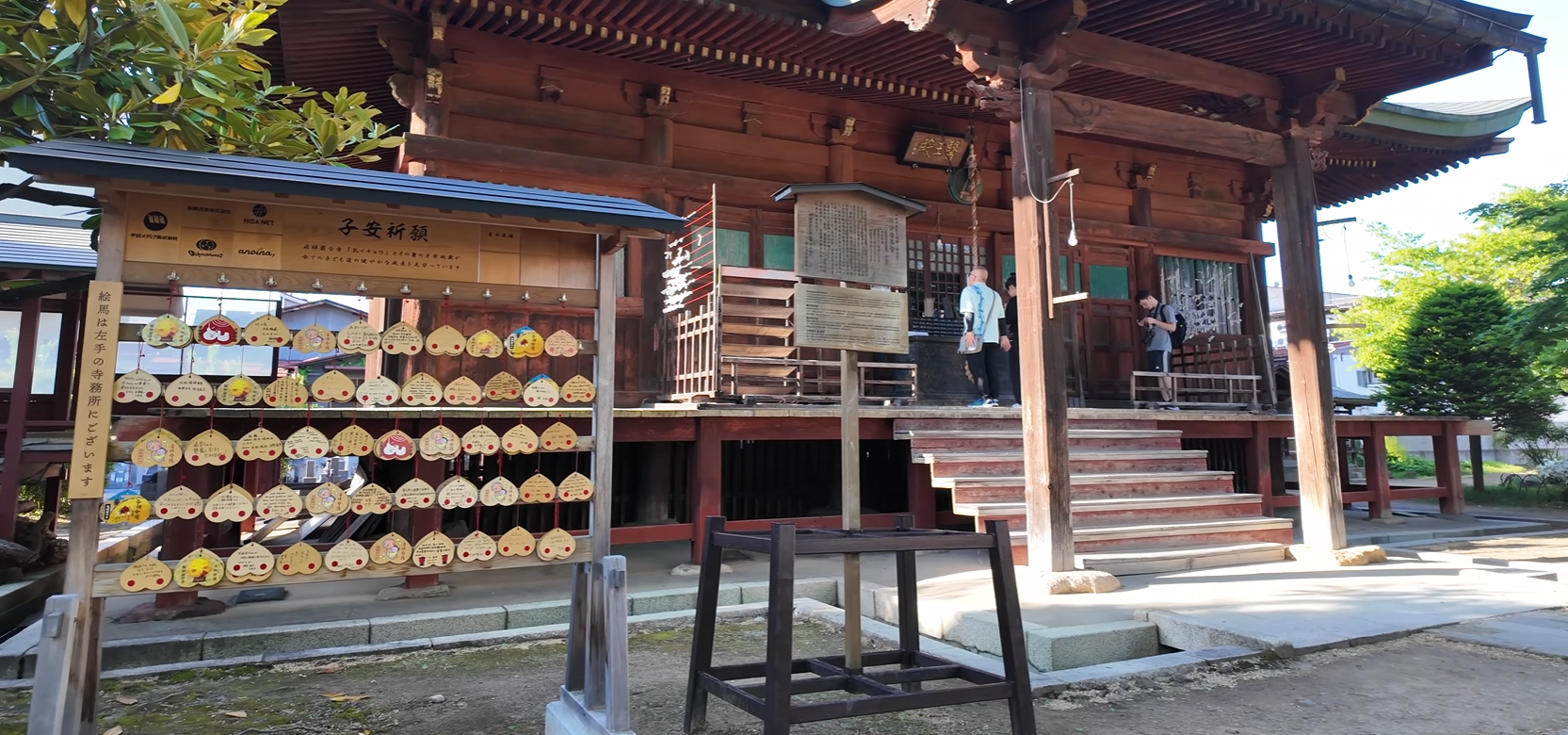
About the temple
Hida Kokubun-ji is Takayama's oldest temple and one of the most venerable in the entire Hida region. Founded in the 8th century by imperial order, it forms part of the network of Kokubun-ji temples established by Emperor Shomu in each of Japan's provinces as spiritual and administrative pillars of the Buddhist state he wished to build. Unlike most historical Japanese temples that were rebuilt or relocated over time, Hida Kokubun-ji preserves its original location and some of its founding elements, including a ginkgo tree over 1,200 years old that is the oldest living witness to Takayama's history. Its tranquil and contemplative atmosphere, away from the bustle of the tourist streets of Sannomachi, offers an authentic experience of what religious life was like in the Japanese Alps for more than twelve centuries.
History
The history of Hida Kokubun-ji begins in 746, when Emperor Shomu issued an imperial edict ordering the construction of a Kokubun-ji temple in each of Japan's more than sixty provinces. This decision, unprecedented in Japanese history, responded to the emperor's vision of creating a unified Buddhist state where each province would have its own spiritual center directly linked to the imperial power in Nara. The temple of Hida Province was among the first to be built, given that the region was known for its extraordinary carpenters — the takumi of Hida, famous throughout Japan for their mastery of wood construction — who would have been summoned to the capital to contribute to the construction of Todai-ji and other great temples of Nara. Building a great temple in their own province was therefore an act laden with meaning for the local community. During the Heian period and the Warring States period, the temple suffered several fires and was partially destroyed on multiple occasions. However, unlike many temples of the era that were abandoned after their destruction, Hida Kokubun-ji was rebuilt each time by the local community, which considered its existence a fundamental part of the region's identity. The three-story pagoda preserved today dates from the late Muromachi period, in the 16th century, and is the only pre-Edo era structure surviving in Takayama. With the arrival of the Edo period and the establishment of direct Tokugawa shogunate control over Takayama in 1692, the temple continued to be an important spiritual center although its administrative power was gradually eclipsed by shogunate institutions. During this period, the temple became a pilgrimage site for inhabitants of the surrounding alpine valleys, who came to Takayama to pray and trade. The Meiji era brought the official separation of Shinto and Buddhism, which economically affected many Buddhist temples in Japan. Hida Kokubun-ji, as a Tendai sect temple, survived this difficult period thanks to the continued support of the local community and its historical importance as the oldest temple in the region.
🎴 Curiosities
The ginkgo tree at the entrance is over 1,200 years old — planted at the time of the temple's founding in the 8th century, it is Takayama's oldest tree and one of the oldest in the Hida region
In autumn, when the millennial ginkgo turns deep gold, the contrast with the pagoda's dark roofs creates one of Takayama's most photographed images — professional photographers travel expressly to the city to capture this moment
The three-story pagoda dates from the 16th century and is Takayama's oldest building. It has been designated an Important Cultural Property of the Japanese state
The Yakushi Nyorai Buddha preserved in the main hall is a Heian period sculpture designated an Important Cultural Property — it represents the Buddha of medicine and healing, a deity especially venerated in rural and mountain communities where access to medicine was limited
The name 'Kokubun-ji' literally means 'provincial national temple' — these temples formed a spiritual network connecting every corner of Japan with the imperial power in Nara, a kind of religious nervous system of the Buddhist state
The temple belongs to the Tendai sect, one of Japan's oldest and most influential Buddhist schools, founded on Mount Hiei near Kyoto. The Tendai sect was the mother of virtually all subsequent great Japanese Buddhist schools, including Zen and Jodo
The Jinya-mae morning market, one of Japan's most famous, has been held steps from the temple since the 17th century. The combination of a dawn market visit and a tranquil temple visit is one of the most authentic experiences Takayama offers
The temple preserves in its museum a collection of religious and artistic objects from the Nara and Heian periods, many unique in the Hida region, documenting more than twelve centuries of religious life in the Japanese Alps
During World War II, the temple was temporarily used as a warehouse by local authorities. The fact that Takayama was never bombed allowed all its artistic treasures to survive intact, unlike what happened in many other Japanese cities
The temple is the traditional starting point of Takayama's Spring Festival (Sanno Matsuri), celebrated in April, when the famous festival floats depart from its surroundings toward the Hie-jinja shrine