About the temple
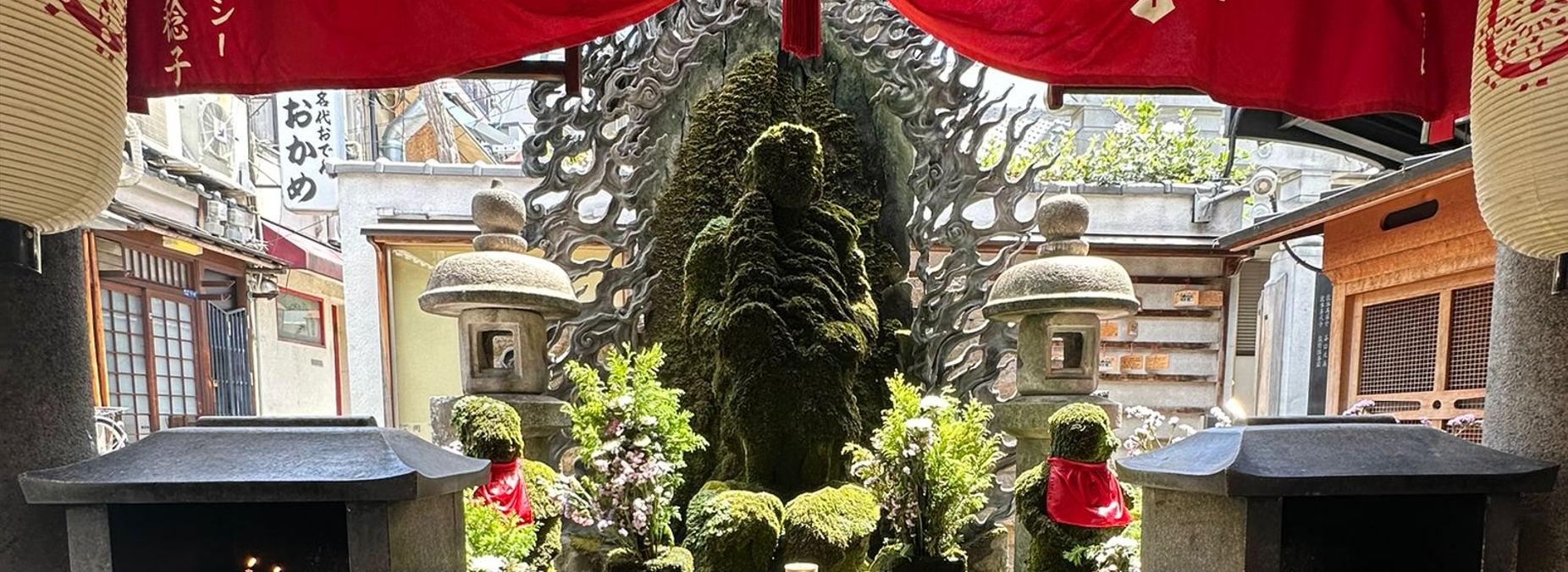
Hozen-ji is one of those places that defy all categories of conventional tourism. Hidden in an alley barely three meters wide in the heart of the Namba district, steps from the bustling Dotonbori, this tiny Buddhist temple of barely two hundred square meters is nevertheless one of the most authentically alive places in all of Osaka. Its main statue of Fudo Myoo, completely covered by a dense layer of centuries-old green moss, is the result of the daily devotion of the faithful who bathe it with water as an offering for over three hundred years. The contrast between the spiritual recollection of the temple and the sensory explosion of the entertainment district surrounding it creates one of the most singular experiences Japan can offer: the perfect coexistence of the sacred and the profane, between meditation and pleasure, which is ultimately one of the most distinctive traits of Osaka's popular culture.
History
The origins of Hozen-ji date back to 1637, when a Buddhist monk established a small altar in this alley in the Namba district to venerate Fudo Myoo, the deity of immovable wisdom, one of the most powerful figures in the esoteric Buddhist pantheon. The temple arose in the heart of the most lively entertainment district in Osaka of the era, surrounded by kabuki theaters, teahouses, restaurants, and pleasure establishments that made Edo period Namba one of the epicenters of Japanese popular culture. From its earliest days, Hozen-ji developed a special relationship with people from the entertainment and hospitality world. Kabuki actors, geishas, cooks, and merchants from the neighborhood regularly came to the temple to pray for success in their respective trades, establishing a tradition of popular devotion that has reached our days virtually unchanged. The deity Fudo Myoo, with his fierce expression and purifying flame, was considered especially effective in protecting those who worked at night and lived on the margins of conventional social respectability. The practice of bathing the statue with water began from the temple's earliest days and became the defining ritual of Hozen-ji. The water that the faithful pour over Fudo Myoo, combined with the humidity of the alley and the passage of centuries, has generated the extraordinary layer of moss that now completely covers the statue, transforming it into a living organic form that changes subtly with the seasons. Osaka devotees consider that this moss is not a deterioration of the statue but its perfection: the deity has been dressing itself in living nature through the accumulated devotion of generations. During the bombing raids of World War II, the Namba district was devastated almost completely. Hozen-ji, however, miraculously survived the air attacks of March 13, 1945, which destroyed 80% of the urban fabric of central Osaka. The neighborhood's inhabitants interpreted this survival as a manifestation of Fudo Myoo's protective power, which enormously reinforced devotion to the temple during the postwar reconstruction years. Writer Yasunari Kawabata, who would receive the Nobel Prize for Literature in 1968, set part of his novel The Master of Go in the surroundings of this temple, immortalized literarily as a place where chance, ephemeral beauty, and the melancholy that characterizes his writing intertwine.
🎴 Curiosities
The Fudo Myoo statue is so completely covered in moss that it is impossible to distinguish its original features — only the eyes, slightly visible through the vegetation, recall that beneath lies a stone sculpture. The temple's conservators consider the moss a sacred part of the statue and never remove it
The alley where the temple is located, known as Hozenji Yokocho, is one of Osaka's most atmospheric: barely three meters wide, paved with stone cobblestones, flanked by dark wood restaurants that have been serving Osaka culinary specialties like kushikatsu and mizutaki for decades
Devotion to Fudo Myoo at this temple has a very particular dimension in Osaka: prayers are especially offered for success in business, love, and the performing arts. Actors from the Shochiku theater company, whose historic theater is steps away, have visited the temple before each premiere for generations
Although the temple is barely two hundred square meters, it receives hundreds of daily visits from locals who stop to pray on their way to work, shopping, or nighttime leisure — it is one of the purest examples of integration of spiritual practice into daily life
Nobel Prize winner Yasunari Kawabata immortalized the atmosphere of this temple and its surroundings in his novel The Master of Go, published in 1951, turning Hozen-ji into a site of literary as well as spiritual pilgrimage
The oldest restaurant in the alley has been in the same location for over eighty years and its current owners are the third generation to pray at Hozen-ji before opening each day — it is a living example of how the temple has integrated into the human fabric of the neighborhood
Fudo Myoo, the temple's main deity, is represented in Buddhist art with a fierce expression, surrounded by flames and holding a sword and a rope — the sword cuts through illusions and the rope binds beings who resist enlightenment. His intimidating appearance conceals an essentially compassionate nature
The temple miraculously survived the 1945 bombings that destroyed 80% of central Osaka, which the neighborhood's inhabitants interpreted as proof of the deity's protective power
In the small temple precinct there is also an altar dedicated to Mizukake Fudo, the Fudo who receives water, where the faithful pour water with a small wooden paddle while formulating their wishes — the constant sound of water on stone creates a meditative sound environment amid the city's noise
Hozen-ji is especially visited at the Setsubun festival (early February), when Osaka devotees come to pray for the expulsion of evil spirits and the arrival of good luck for the coming year