About the temple
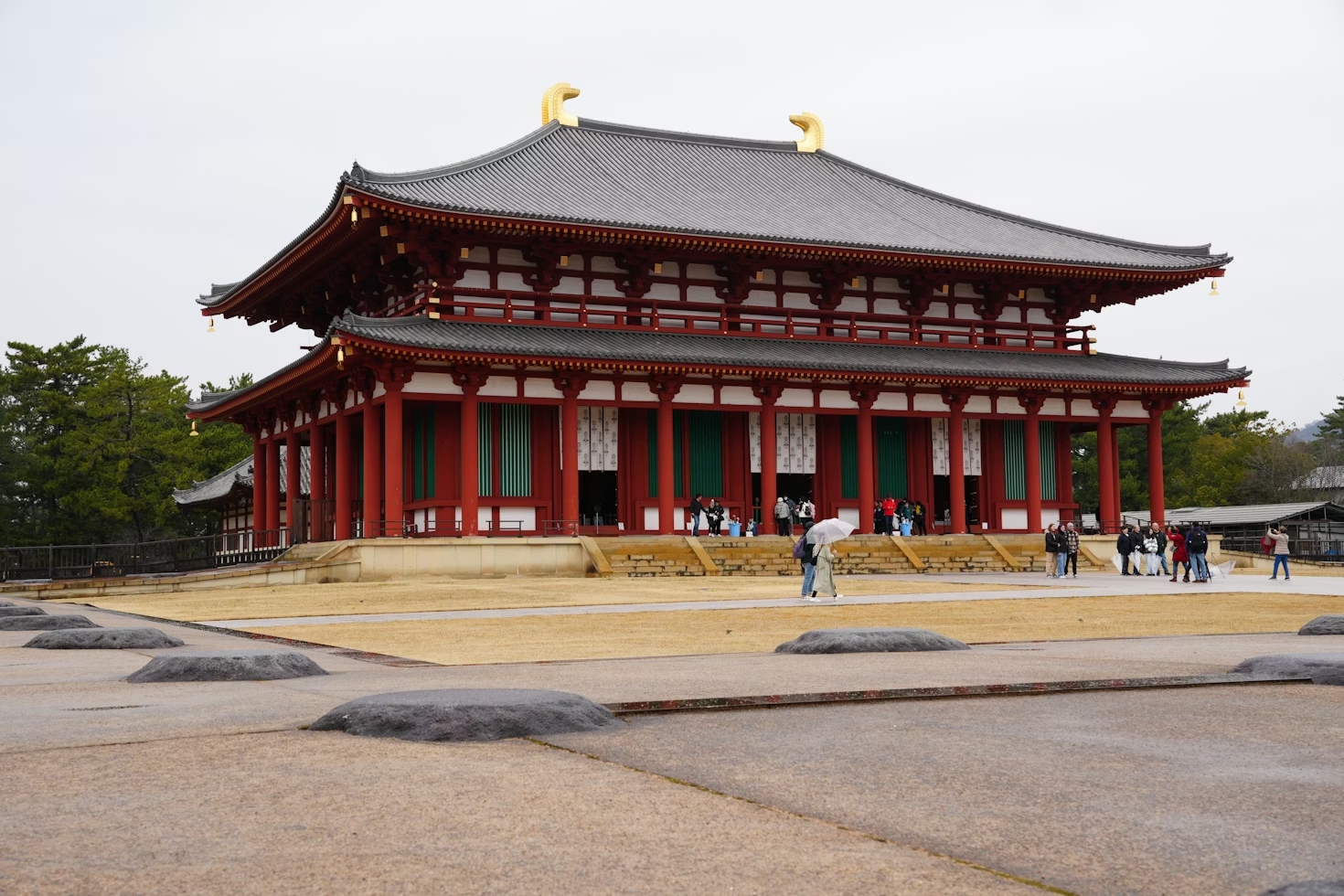
Kofuku-ji, one of the oldest and most influential Buddhist temples in Japan, stands in the heart of Nara Park as a living testament to the power of the Fujiwara clan and the glory of the ancient capital. Its iconic five-storied pagoda, 50.1 meters tall, is majestically reflected in Sarusawa Pond and is one of Nara's most recognizable symbols. Founded as the family temple of the powerful Fujiwara family, this complex —which at its peak had more than 150 buildings— combines imposing architecture with an extraordinary collection of artistic treasures. As the head temple of the Hossō sect (Yogācāra), Kofuku-ji is part of the Historic Monuments of Ancient Nara, declared a UNESCO World Heritage Site. Walking among its halls, pagodas, and national treasure statues is to step into the spiritual and political heart of Japan during the Nara and Heian periods.
History
The history of Kofuku-ji begins in 669, when Kagami no Ōkimi, wife of the statesman Fujiwara no Kamatari (founder of the Fujiwara clan), established a small Buddhist chapel called Yamashinadera in present-day Kyoto Prefecture to pray for her husband's recovery from illness. After the Jinshin Rebellion of 672, the temple was moved to Umayasaka (renamed Umayasakadera) and, finally, in 710, it was relocated to its current site coinciding with the move of the capital to Heijō-kyō (present-day Nara). Under the patronage of Fujiwara no Fuhito, son of Kamatari, the temple was named Kofuku-ji (“Temple that Generates Blessings”), inspired by the Vimalakirti Sutra. It quickly became one of the Seven Great Temples of Nara (Nanto Shichi Daiji) and the tutelary temple of the Fujiwara clan, which dominated Japanese politics for centuries. At its peak it had more than 150 buildings. Over the centuries it suffered repeated fires and destructions, especially during the civil war of 1180 caused by the Taira clan. The five-storied pagoda, originally built in 730 by order of Empress Kōmyō (daughter of Fuhito), has been rebuilt several times; the current one dates from 1426. After the Meiji Restoration and the policies separating Shinto and Buddhism, it lost much of its land, but preserved its most important artistic treasures.
🎴 Curiosities
The five-storied pagoda (Gojū-no-tō), 50.1 meters tall, is Japan's second tallest wooden pagoda (only surpassed by To-ji in Kyoto). Originally built in 730, the current one dates from 1426 and is a National Treasure
The Ashura statue, one of the masterpieces of Japanese Buddhist art, is a figure with three faces and six arms made using the dry lacquer technique in 734. Its serene and melancholic expression has made it one of Nara's most beloved and photographed statues
The National Treasure Museum (Kokuhōkan) houses an exceptional collection of Nara-period statues, including the Eight Classes of Mythological Beings (Hachi Bushū) and the Ten Great Disciples of Buddha. Many are National Treasures
At its peak, Kofuku-ji occupied much of what is now Nara Park and had more than 150 buildings; today several important halls remain, such as the Tokon-dō (Eastern Golden Hall) with a statue of Yakushi Nyorai and the Nan’en-dō (Southern Octagonal Hall)
The temple is the head temple of the Hossō sect (Yogācāra), one of the oldest Buddhist schools in Japan, focused on the study of consciousness
Next to the temple is Sarusawa Pond, where the pagoda is reflected with special beauty at sunset or during cherry blossom season
Although many buildings were destroyed by fires and wars, the faithful reconstruction of structures like the pagoda has preserved the spirit of the original temple
Kofuku-ji is part of the Historic Monuments of Ancient Nara, inscribed as a UNESCO World Heritage Site in 1998
Near the temple live Nara's famous sacred deer, which often wander among visitors and historic structures, creating a unique atmosphere