About the temple
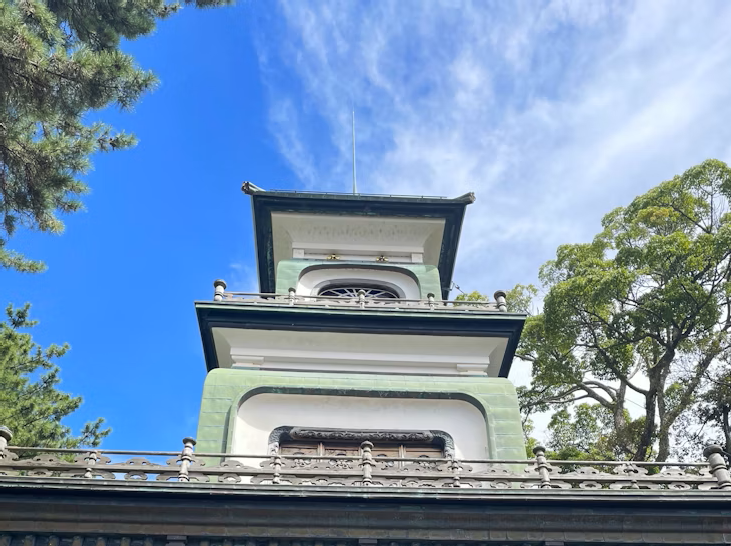
Oyama Jinja is one of the most unique and symbolic shrines in Kanazawa, a place where the history of the Maeda clan meets the architectural boldness of the Meiji era. Dedicated to the spirit of Maeda Toshiie, founder of the powerful Kaga domain (which ruled the region for over 280 years), and his wife Maeda Matsu (Omatsu), this shrine stands out for its impressive Shinmon (divine gate), a three-story structure that fuses Japanese, Chinese, and Western styles with colorful stained glass and a lightning rod considered the oldest in Japan. Located near Kanazawa Castle and the famous Kenrokuen garden, Oyama Jinja offers a fascinating contrast between Shinto tradition and 19th-century modernity. Its round-pond style garden, with bridges shaped like ancient musical instruments (such as the biwa), is magically illuminated at night, creating an ethereal atmosphere that attracts both locals and visitors. It is a space that honors the legacy of Kaga's "one million koku" and Japan's opening to the world.
History
The history of Oyama Jinja dates back to 1599, shortly after the death of Maeda Toshiie (1539-1599), the first daimyo of the Kaga domain. His son, Maeda Toshinaga, wanted to honor his father as a kami, but as a tozama daimyo he could not do so openly under the Tokugawa shogunate. Therefore, he initially established Utatsu Hachiman-gu on Mount Utatsu, where Toshiie was venerated alongside other deities. After the Meiji Restoration and the abolition of the domains (1871), the former samurai of the Kaga domain decided to permanently honor their founding lord. In 1873 (Meiji 6) the shrine was built in its current location, on the grounds of the old Kanaya Goten (retirement residence of the Maeda family), and named Oyama Jinja (referring to the old name of the region governed by Kaga). The famous Shinmon was completed in 1875 (Meiji 8), designed in collaboration between a Dutch architect (Holtman) and the local master carpenter Tsuda Kichinosuke. In 1998, the veneration of Maeda Matsu was also added. Today it is a shrine of the Association of Shinto Shrines (Jinja Honcho) and one of Kanazawa's most beloved places, a symbol of the transition between feudal and modern Japan.
🎴 Curiosities
The Shinmon (divine gate) is the main attraction: a three-story structure that mixes Japanese and Chinese styles at the base with Western elements (including Dutch colored stained glass on the upper floor). It once functioned as a lighthouse for ships in the Sea of Japan and has Japan's oldest existing lightning rod
The inner garden is in “round-pond” style with an artificial island and bridges shaped like ancient musical instruments (such as the biwa). It is illuminated from sunset until 10:00 PM, creating a fantastic and highly photogenic atmosphere
On the grounds there is a bronze statue of Maeda Toshiie with his characteristic “catfish-tail” helmet (namazu-ō), a symbol of his status, and another representation of his wife Matsu
It is especially venerated for benefits such as success in studies and martial arts (bunbu ryodo), victory in battles or competitions, marital harmony, and safe childbirth
The eastern gate (Higashi Shinmon) is older and dates from the Azuchi-Momoyama period, decorated with dragon carvings
Oyama Jinja is considered the “general” or protective shrine of all Kanazawa, and receives many visits during Hatsumode (first shrine visit of the year)
In the Meiji era, the design of the Shinmon was so innovative and “Westernized” that it generated controversy and plans for reconstruction that were never carried out
In addition to traditional omamori, there are unique varieties inspired by the Maeda clan's history and Toshiie's helmet
The shrine is very close to Kenrokuen and Kanazawa Castle, making it an ideal stop on any route through the historic center of the city